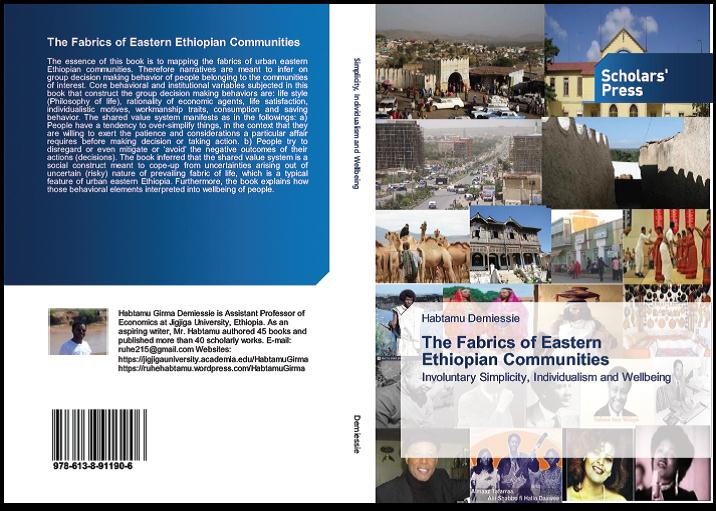
INVOLUNTARY SIMPLICITY, INDIVIDUALISM AND WELLBEING
Author Habtamu Girma Demiessie, Assistant Professor of Economics at Jigjiga University
SUMMARY ON THE BOOK
The essence of this book shall be understood for being thought provoking work. The bulk of narratives lies in hypothesizing and attempting to justify on behavioral and institutional elements shared by people and/or communities of eastern Ethiopia. To that end, the whole set of narratives were in line of addressing the followings: a. Is there a value system (Philosophy of life) shared among communities within eastern Ethiopia, as reckoned in the book simple life style in eastern Ethiopia settings? b. What are pillars and peculiarities of simplicity in eastern Ethiopia settings? Or what are behavioral and institutional elements of valued lifestyle? c. How the concept of simple lifestyle interpreted into hedonic, eudamonic and affective wellbeings of individuals? d. How shared lifestyle implicated into key variables to wellbeing of communities: the incentive system, individualism, consumption, saving, the nature and workings institutions (both formal and informal)? e. What lessons the academic circle and policy practitioners draw in their respective endeavors aimed at promoting the wellbeing of people and communities? f. How better policy regimes can address community development and collective wellbeing in general and in the context of Eastern Ethiopia in particular?
In an effort to address its objectives, which are outlined above, the book relied on three interrelated approaches of making inferences i. ethnographic approach ii. technique of characterization, comparative analysis & conceptualization iii. Formative research approaches.
Ethnographic account was by far the core technique of inference on the essence, pillars, nature and workings of shared norms and value system amongst people belonging to communities of eastern Ethiopia. Those efforts were consolidated by theoretical and empirical evidences gathered from host of fields of social science and strands of thouguts: conventional (orthodox) economics, institutional economics, behavioal economics, postive psychology, social psychology, economic sociology, social anthropology, economic anthropology, business management, behavioral geography, history, among others.
In a bid to frame, consolidate, identify and explain on peculiaities of shared behaviroal and institutional elements, a technique of characterization, comparative analysis & conceptualization was used. As such, a comparative look across different socio-cultural setups, value systems, social structures, faiths (religions), systems of governances, livelihood systems, family types & structures, generations were made.
In its formative aspect, the book tried to take inferences on possible implications (to wellbeing of people and communities) of shared behavioral and institutional elements.
As source of information, the book relied upon both primary and secondary sources. As the author is involved in the community for a decade, personal observations was vital source of inference. Moreover, the topic at hand was tabled for discussion and debate on the Third Annual Conference on Eastern Ethiopia Economic Development, which was held in Jigjiga city in November 2014.
The book forefronted that there exists shared lifestyle among people belonging to east Ethiopia communities. The shared lifestyle is result of common background of those communities in the past and present, in terms of variables in the domian of socio-cultural, belief & value system, economic, governance, geo-political, among others.
In general, the behaviors (motivations) of peoples and institutions (formal or informal institutions) prevalent in eastern communities, are reflections of the following two values:-
People have a tendency to over-simplify things, in the context that they are unwilling to exert the patience and considerations a particular affair requires before making decision or taking action.
People tries to disregard or even mitigate or ‘avoid’ the negative outcomes of their actions (decisions).
One may consider the mentioned values and implied motives reflections of irrational mindset. But inferences made point out otherwise, putting such value judgment misleading, if not unfounded. What the book concludes is that the cherished lifestyle in eastern Ethiopia communities is behavioral and institutional mechanisms that people and communities designed in a bid to avoid or mitigates risks and/or deprivations of material and/or spiritual (emotional) wellbeing triggered by the prevailing uncertain environment attributed to socio-economic, livelihood, geo-political, geographic and governance factors, among others.
To frame and define the unique lifestyle cherished by easterners, the book relied on the theoretical framework by Duane Elgin (2010), which conceptualize simple lifestyle based on a particular value of people. Therefore, the book conceptualized the unique lifestyle cherished as Simple Lifestyle in Eastern Ethiopian Settings. The suffex ‘in Eastern Ethiopian Settings’ entails to emphasize the fact that though the shared values have a lot in common with the concept of simple lifestyle we have in the literature, it has some deviations and peculiarities.
The conventional narratives on the concept of simplicity entails people’s deliberate and voluntary disregard to material acquisition. On the contrary, in the eastern Ethiopia context, simplicity is neither deliberate, nor is voluntary.
Moreover, in the conventional narratives of simplicity, the concept is understood at an individual level, where its depiction is blurred on the importance of social and institutional elements. In the eastern Ethiopian context, however, simple life style has behavioral and institutional aspects, which implies simple life style to inscribe individual and social elements.
The concept of simple lifestyle is such a deep concept that it explains the underlying behavioral and institutional arrangements in relation to such concepts implicated into the wellbeing of people, like individualism, consumption and saving. In this regard, the conventional theoretical and empirical evidences on those concepts doesn’t give full pictures on the essentials in the context of eastern Ethiopia communities.
In general, simplicity, as we understand in eastern Ethiopia settings encompasses individualistic motives. The book tries to model those individualistic motives of people in a concept referred in the book as individualism proper.
The way the concept of individuism works in eastern Ethiopia settings is analogous to the way conventional individualism functions. Under the free market order (capitalism), which is powered by conventional individualism, the concept of invisible hand is what molds individualistic motives so that people act responsibly.
Simplicity peculiar to eastern Ethiopia communities, in its institutional aspect, is analogous to the concept of invisible hand . As such, the installed social sanctions mechanism regulate misbehaviors of individuals lest corrupting the behavioral and institutional elements meant to preserve the wellbeing of people and harmony of communities, where those guilty would be isolated from social business. In a community where virtually every aspect of life is socialized, one cannot afford to lose on those ground.
That explains (without excluding other factors) why norms, values and social capital are powerful forces governing life than conventional laws, rules and principles in the context of eastern Ethiopia communities.
Consumption and saving too, have quite a different look in eastern Ethiopian settings. Behavioral and institutional factors determining consumption and saving in those communities of interest were largely fit the wider characterizations made on simple lifestyle. As such, both consumption and saving have material and spiritual components.
One interesting feature of consumption and saving in eastern Ethiopia settings is that they go simultaneously. In that, behavioral and institutional elements of the cherished lifestyle can be taken for granted as core elements molding consumption and saving decision making of people.
This book further makes inferences implied by shared motivation (behavior) and institutional elements (socio-cultural institutions and implied norms and value system) in the context of peoples` socio-economic life. In this regard, the valued life style in east has a number of positive and negative implications to wellbeing of people and communities, which can attract the attentions of academicians and policy practitioner to consider those variables in their respective careers.
Therefore, academic and research community has to provide the public policy with evidences on why and how those variables could be considered while designing and implementing policies, programs and projects aimed in service of communities of interest.
Moreover, regional governments, higher education institutions, tink-tank groups and research centers in Ethiopia in general and those working in Eastern Ethiopia in particular has to commit resources where in-ward looking initiatives promoted & enriched, complement endeavours set to optimizing indigenous knowledge and promote progressive value systems & informal institutions.
 ሩህ ሚዲያ - Ruh Media
አስተያየት ያስቀምጡ