• How Better Ethiopians Survive Mounting Cost of Living?

    Habtamu G. Demiessie

    For Readers Part of this piece was published on Addis Fortune, Ethiopian Based News Paper. Readers may find it online via this link: https://addisfortune.news/rising-cost-of-living-in-addis/

    Introduction

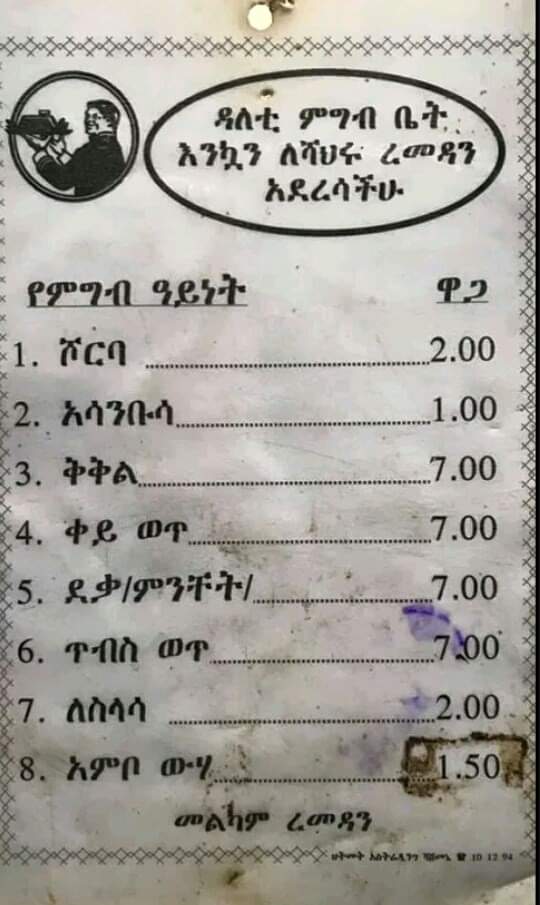
    As I was wandering on Facebook pages, I met with a picture about food menu. Perhaps, it was from an average restaurant in Ethiopia, a quarter of century before. That was a reminder on my childhood memory about our economic life. I asked myself if those times were in fact good times, in terms of ease of economic life. And I found those price tags on the menu were misleading if one may take the face value, and miss important elements while comparing then and today in terms of betterment of economic life.
    Even from the outsets, can we consider a price tag differential a proxy variable on cost of living differential in Ethiopia, now versus 28 years? Why? And how can possibly adjust the geometric increase in prices with almost arithmetic increase in our average income at country level? Let me opine on those and related issues.


    A glance at the attached menu on food price tag from 28 years back bears in one’s mind another menu about food price tag on current price. Given food expense sweeps almost 70 per cent of an average household income in urban Ethiopia, comparison on the menus can give a rough estimate on how costlier life is today than was 28 years back.
    But, without some factors worth considering, the food price differential would be all too nominal,and cannot give a real picture to give a right estimate on cost of living differential.
    For a fairer evaluation of today’s economic life against 28 years back, one has to take into account important factors which depicts the right economic dynamics since. In this regard, at least in the Ethiopian context, two factors worth mentioning are: ease of earning money and scarcity premium. Hence, it takes to deflate the cost of living against those factors.
    As a matter of fact, the cost (exertions) of earning one birr then (25 yes back) and today is dear in favour of the former. For instance, for a civil servant who used to be paid 600 birr by then, and is earning 2400 birr 2day, the cost of earning birr is 4 folds cheaper now (N.B the hours of work per day and per month is unchanged but salary raised four folds. ).
    In addition, just to arrive a balanced judgment on the cost of living, it takes to adjust for a scarcity premium as another deflating factor. As a matte of fact, nature is much more exploited 2day than 28 years before. Hence, scarcity premium must be added on the final price of goods & services consumed.
    But, one may argue the margin of exploitation of nature is compensated by technical advancement or integrating knowledge(knowhow), all contributing for an efficient and production system, hence helping lift a stress on the bounty of nature. Indeed, this argument may holds water
    However, given the Ethiopia production system is far less coping what the rate of scarcity requires, we can’t relieve(be resilient of) the rising cost of living manifested by higher scarcity premium we are expected to pay. That is manifested by an average income of people lagging behind what it costs them survive a dignified life.
    In my opinion, why Ethiopians are faced with costlier life today is because prevailing production system is lagging behind what is required to be in a time. The implication is clear: a resolve for rising cost of living would be rethinking the way we produce, and revisiting our conception on the essence of work.
    For an average Ethiopian, understanding on work is like a classical conception on work, which attributes work much more on physical exertions than mental. And that defines the Ethiopian way of measuring the value of work, and a worker too. For many of us work is how long we spare in an office or a workshop or a field site. For us, workers are by default those who stay long hours at office. We rarely measure work ( and workers) by efficiency and productivity.
    So, where is a way-out from a costlier economic life then?
    As I suggest it to be, the cure from an economic headache caused by a rising cost of living is revisiting our work culture & our conception on work. That in turn results in making our production system supported by workmanship, thought and systemic. That is the only way to catch up the rising scarcity premium, hence enable us to survive economic hardships. That is what has to define the course of our future.
    Otherwise, we have to prepare ourselves how best we may endure the inevitable trap, or say it a crisis, threatening us all eat one another to survive.
    May God help us for a better tomorrow.

  • BACK TO THE FUTURE !!!

    Past Through Window of Present

    By: Habtamu G. Demiessie

    Like most of my fellow Ethiopians, I assume, am trying to figure out the underlying reason behind the recent incidents that have claimed the lives of innocents and threatened the peace, stability, unity and harmony of nations, nationalities and people of Ethiopia. I cannot hide my fears that, unless swift responses are implemented, Ethiopia is on the edge of becoming a failed state, though this is debatable. The reason, in my view, is the inaccurate understanding of history, or the interruption of it.

    Ethiopians on the Edge of Mass Confusion

    Of course, mass confusion is not new but has been a growing phenomenon in recent years and months. Amongst all the diagnosis and prescriptions analysts and politicians front though, the most sensible is one that has to do with how we have come to view our history.
    For this, the political system is to blame, which in essence is all about how the politics of a country operates. This includes how political groups engage in the political market. Those that are commendable allow and guarantee the wider populace all the means and tools to seize the ultimate power and role in exercising political rights. The corollary of that is an ideal political system where citizens are free from elitism; the rule of the game then becomes logic and principles.
    Looking into the Ethiopian political system, what governs political elites, both on the ruling and the opposition lineup, has been otherwise. The political elites often count on the corrupt narratives and wrong interpretation of history. That is by far the source of the mass confusion threatening Ethiopia.
    A glimpse into the political history of the country entails that politicians have incessantly fanned the flames of mass confusion, at least in two ways. One is how the governing circle has understood history, where they divide it into evil and good, while history is neither right nor wrong, but irrelevant altogether. The past may depict the fraternity or animosity between groups or people, but what matters is whether or not lessons have been learnt.
    Hence, our past, which in some instances saw an Ethiopia in war with itself, and at another, the unity of the nation under one flag. History is a medium to learn.
    To borrow words from the timeless Ethiopian poet Tsegye G/Medehin, roughly translated to, “a wise man learns either from school or his sufferings.”
    Indeed, it is up to a man himself to choose which medium to take lessons from. Perhaps as has been witnessed with the recent wave of unrests, unless engulfed in mass confusion, Ethiopians would not have opted to go down a path that reverberates to this day to create chaos.

    Corrupt Interpretation of Ethiopian Past

    The second source of mass confusion is the interpretation of history. The politicians often appear with an agenda that are supposedly tailored to heal past wounds. This has been by addressing specific groups as losers under previous regimes. Attempting to cure past mistakes by benefiting one over the other, they have allowed old wounds to fester. Indeed, such a flaw is without an execuse, as history repeats itself twice, and not always with an opportunity to learn from it.
    With a past that can create confusion and hatred, it takes all Ethiopians and political groups to redefine the essence of history. There needs to be discussion and reflection. But any supposed quick fixes or shortcuts will lead to demise.
    Another face of Ethiopian political system is that there is a lack of commonly shared values, which would have bound the different political groups into one, irrespective of their diverse opinions and interests. Such a value system is an essential driver of people in all departments of their life: be it social, economic or political.
    By fashioning into the decision-making behaviour of people at all levels and aspects of life commonly shared values that all are willing to abide by, we can shape the nature, form and functionality of formal and informal institutions which will amount to creating a welcome foundation for political, economic and bureaucratic governance.
    Without values Ethiopians can share, they cannot find a political answer to their questions. Where such is the case, pointing fingers among competing political parties is nothing more than senseless. Those at the higher echelons of power are but a mere product of the prevailing political system, where rules, principles and logic have little say on sociopolitical issues.
    To escape from the political impasse and consequent woes, what is expected from all Ethiopians, mainly the current generation are an understanding of the time concept and devising a uniting philosophy that can accommodate all languages, cultures and religions.
    Time shows us the present via the image of yesterday; it endows us with the wisdom to understand why and how history matters. With historical narratives that are often taken for granted, differences in the interpretation of history is not just the source of disagreements amongst political groups, but a polarizing issue within the populace.
    But the time concept is not a prison and there are ways of breaking out of it. And doing will not just shade a light on the political landscape, but can be a great asset in promoting political stability, a better political system and a national consensus.

    What is expected of Ordinary Ethiopians?

    As I consider nation-building to be the foremost task of our generation, Ethiopians have to properly understand the time concept as it severely affects decision-making ability over key political issues, where stereotypes and personality cults play a negative role. A proper time concept will endow Ethiopians with the ingredients of fair judgment on historical incidents, creating a path towards political dialogues and reconciliation.
    And let us not forget about a nationally shared value, where the United States (US) is a great example. After taking their independence from Great Britain in the 18th century, the Americans needed a philosophy to bring all their diverse communities – the Colonies – together. Great American personalities, like Benjamin Franklin, were at the forefront of this great search. They came up with the idea of the genesis of the individual as the pillar of American political and economic order, a philosophy that endures to this day.
    In countries like Ethiopia with diverse languistic-cultural and religious exist, devising a commonly shared value presupposes all political and economic agendas. It will not only unite people as one country but also become the source of strong institutions that mould the economy and politics.
    Ethiopians can learn a lot from the genesis of Western countries, which integrated those values that founded the type of democratic and healthy economic situations of today. This is a task for academicians, particularly social scientists and economists. Political groups have to likewise contribute their part. But the biggest share will have to be played by the youth, without whom any change is impossible.

  • RETHINKING DEVELOPMENT DISCOURSE

    A BETTER WAY TO DEVELOPMENT THEORY AND PRACTICE IN THE SETTINGS OF THIRD WORLD ECONOMIES

    Note for Readers:- This article first published on Journal of World Economics Association, WEA Commentaries. Readers can find full readings from the original source following this link: https://www.worldeconomicsassociation.org/newsletterarticles/better-devel-theory-practice/

    INTRODUCTION

    The ultimate objective of academia and policy regimes lies in promoting the wellbeing of people. Hence, devising theoretical and practical tools meant to scale up the well-being of people and communities takes the core of academic and policy endeavours. Looking particular context of developing world, however, the teachings and practices on issues of well-being is blurred, if not too abstract. As emerging emperical evidences from development literature suggest, old way of looking the theory and practice meant to address the welfare of communities doesn’t appeal to particular contexts prevailing in developing world. As a result of that, it is not unusual to witness development policies to have remained impotent. As a postgraduate student of economics, I remember what our professor told us from his rich experience in development teachings and practices.in Ethiopia and other countries in Africa. Worth recounting, in this regard, was why communities often are nostalgaic about past. It is becoming customary in development discourses that post intervention studies carried out often end up unexpectedly, where subjects far less content with and even plea for the pre-intervention days. This is despite communities' material needs are better served as a result of interventions aimed at community development. More often than not, development theorists and practitioners are unable to explain those instances, which they ascribe it to a paradox, as nostalgia effect. In my view, if one thoroughly look into the issue, there is nothing a paradox with nostalgia effect, and it could be explained. The pillar of my assertion goes to the conventional teachings and practices on development, which I alleged for corrupt understanding on the concept of well-being. The dominant narratives in development literature takes for granted development synonymous with material fulfillment. By far, the role and importance of non-material aspects of life are considered a residual.

    So, Whom to Blame then?

    As to my understandings, the very reason why developing countries are underdeveloped is because of corrupt education and policy regimes. With todays teachings are tomorrow`s policies, where there is a fault in the education system, there would be mess in the policy regimes and overall governance system too. One can fetch from development literature on the link between the education system and underdevelopment. Dependency theory, one of the post-colonial development theories, has controversial but an important narrative as to why developing countries are underdeveloped. Dependency theory begins by segmenting the whole world as developed and underdeveloped, not only for economic or structural reasons, but also on the nature characterizing their relationships. False paradigm hypothesis, a subsidiary of dependency theory, explain the sort of interactions between developed and developing world typified as unfair, even not less of deceptive. Its narratives goes where developed world has been injecting misleading the curriculum and policy regimes to weaken countries on the ‘periphery’ of development horizon. Some hardliner intellectuals even dub such a relationship between the two polar worlds as post-modern colonization. Their lines of argument is that the education system is the major tool of post-modern colonization.The assertions of structural economists goes that the intellectuals and policy practitioners of developing world are the products of those corrupt education systems, and hence it is far-fetched that they would come up with theoretical and policy tools which remedies developmental challenges of their people.
    In my opinion, one shall not overlook the views of dependency theory. Indeed, a number of empirical evidences attest that education system and policy regime of developing countries, including Ethiopia is incompatible to institutional, structural and socio-cultural and value systems specific to their people and communities in general. According to those studies, the bedrocks of underdevelopment in developing countries is ‘one size fits all’ principle molding the academic and policy regimes. Some manifestations of this problems are: overlooking the importance of indigenous knowledge to promote the well-being of people; considering all the western ideals and thoughts are righteous (went up to the extent of cult). On the other hand, local wisdoms were taken as irrelevant or not modern.
    In many instances, challenging those corrupt educational systems and policy regimes have been punished. Intellectuals who defies the western thoughts and emphasized the need to look inward encounter setbacks, where their works often portrayed as sub-standard and irrelevant. Their works would also hidden lest disseminated and enlighten the victims. Therefore, where such is a governing reality in the academia and policy regimes , expecting the academicians, researchers, policy makers and/or implementing bodies to remedy the complex developmental challenges of their people and communities is like expecting honey from a fly, as one Amharic proverb goes.

    What is expected of the academia and policy circles ?

    My suggestion lies in the need to challenge the conventional development theory and practices, which makes its principle one size fit principle, from philosophical, theoretical, methodical and policy perspectives. Hence, it is expected to pinpointing alternative wayouts of underdevelopment and promoting wellbeing of people and communities in developing world in general. More specifically, it takes to confront against one of the reflections of the dysfunctional education and policy regimes prevailing in underdeveloped world, which is ‘disregard to the role and/or importance of socio-cultural institutions of communities in defining the fabrics of all aspects of governance and public life. To that end, key areas of emphasis ought to be exploring the linkage between behaviors (motivation) of people on one hand, and the overall environment on the other hand. It also takes to model the behavioral and institutional elements specific to developing world, focusing on the unique conditions of particular communities. Academic endeavors are also expected to draw inferences on the behavioral (motivational) and institutional or structural elements in line with possible implications to the well-being of people and communities of interest.
    All in all, academic and policy circles are expected to depart from the conventional paradigm. As such, development theories has to make their constructions on an interdisciplinary approach. Therefore, diverse fields of social science and methodological approaches has to be sought in synthesizing, explaining and making inferences on the wellbeing concept. Development policy should also be redesigned in a fashion to being an in-ward looking. This is to mean, rather than adhering a top-down approach, policy regimes should be designed and formulated on the local realities and contexts. While setting accounts on development practices a host of variables needs to be consulted. As such, formulating policies and strategies aimed at promoting the welfare of communities should take into account factors in the realm of economics, sociology, anthropology, psychology, past system of governance, history, geo-politics & geography, among others. Such is how the academic and policy regimes revisited to better serve the expectations of helping achieve collective wellbeing.

  • ጅግጅጋ በዚያች ቀውጢ ቀን

    በወሳኝ ወቅት የተገለጠው የሶማሌ ወንድሞቻችን ኢትዮጵያዊ አብሮነት

    ሀብታሙ ግርማ

    በጅግጅጋ ዩኒቨርሲቲ የኢኮኖሚክስ ትምህርት ክፍል መምህር

    አንባቢያን እንዲያስታውሱት፦ የዚህ መጣጥፍ አላማ ሐምሌ 28 ቀን 2010 ዓ.ም በተለይ በጅግጅጋ እና አከባቢዋ የደረሰውን አስነዋሪ ድርጊት አንደኛ አመት ስናስታውስ ነገሩን የምንረዳበትን አጠቃላይ አውድ ማሳየት፣ በመሆኑም በተለይ በአደጋው ቀጥተኛ ተጠቂ የሆንን ሁሉ በዳያችንን በአግባቡ እንድንለይ ለማሳሰብ ነው። ከዚህ አንጻር አንባቢያን በኢትዮጵያ ታሪክ ሕዝብ በሕዝብ ላይ ተነስቶ እንደማያውቅ እንድናስታውስ (እንድንገነዘብ) ማስቻል ነው። በተለያዩ ዘመናት ኢትዮጵያን ያስተዳደሩ ገዢዎች ሕዝቡን ከፋፍለው ለመግዛት እንዲያመቻቸው አንዱን ጠላት ፣ሌላውን ወዳጅ በማድረግ ህዝብን እየማገዱ ስልጣናቸውን ሲያደላድሉ የኖሩበትን አስቀያሚውን የኢትዮጵያ የሥነ መንግስት ታሪክ በማስታወስ የሐምሌ 28ቱ ድርጊትም መታየት ያለበት ከዚህ አንጻር መሆኑን አንባቢ እንዲገነዘብ ነው። የመጣጥፉ ዓላማ በዋናነት ሀምሌ 28/2010 እንደተስተዋለው የኢትዮጵያ ህዝብ የመሪዎቹን ሴራ ተቋቁሞ ለዘመናት በአብሮነት የመኖሩን እውነት በዚያች ጥቁር ቀን ከሶማሌ ኢትዮጵያዊያን ወንድሞቻችን በታየው አብሮነት ለመግለጥ ነው።

    ይህ መጣጥፍ የተዘጋጀው የሐምሌ 28/2010 ዓ.ም ጥቃት በተፈጸመ ሶስተኛው ወር፣ ጥቅምት 28/2011 ዓ.ም ነበር። መጣጥፉ በሪፖርተር ጋዜጣ ለንባብ በቅቷል (ከታች የተመለከተውን ሊንክ ይጫኑ)። አሁን ደግሞ የአደጋው አንደኛ አመት በማስመልከት መጠነኛ የርዕስ እና ይዘት ቅርጽ ማሻሻያ ከማድረግ በቀር በአብዛኛው እንደወረደ የተዘጋጀ ነው። https://www.ethiopianreporter.com/index.php/article/13810

    እንደ መግቢያ

    ኢትዮጵያዊያን አስራ ሶስቱን የአመቱን ወራቶች በልዩ መገለጫቸው ማንሳታቸው የተለምዶ ነው፤ ለምሳሌ በደገኛው ነዋሪ ዘንድ የሐምሌ ወር በነጎድጓድ በታጅቡ ጥቁር ደመናማ ቀናት ይታወሳል፤ ይህ ግን ለምሥራቁ የኢትዮጵያ ክፍል፣ በተለይ ለሶማሌ ምድር አይሰራም። ሶማሌዎች Heeg-Heeg በሚል የሚጠሩት ባለአሸባሪ ድምጽ ያለው ነጎድጓድ እና ሐምሌ ወር ትውውቃቸው እምብዛም ነው። ያሳለፍነው ዓመት ሐምሌ ወር የመጨረሻ ሶስት ቀናት ግን ባልተለመደ ሁኔታ መላው የሶማሌ ክልል በአስገምጋሚ ነጎድጓድ ተመታ፤ ነጎድጓዱ የተፈጥሮ አልነበረም፣ ራሱን ‘Heego ወይም ነጎድጓዶቹ’ ብሎ የሰየመው የተደራጀ ቡድን የጎሰመው የእልቂት ነጋሪት እንጂ።
    ከሐምሌ 28 እስከ 30 ቀን 2010 ዓ.ም የዘለቀው ይህ ሰው ሰራሽ ነጎድጓድ የበርካታ ንፁሃንን ህይወት በልቷል፤ የታዳጊ ልጃገረዶች፣ ወጣት ሴቶች እና እናቶችን የሴትነት ክብር ደፍሯል፤ የግለሰቦች እና የመንግስትን ንብረት አውድሟል። በአጥፊዎቹ ላይ ክስ የመሰረተው የፌዴራል ጠቅላይ አቃቤ ህግ ለፍርድ ቤት ባሰማው የክስ ጭብጥ የጥፋት ሐይሎቹ ድግስ የብሔር እና(ወይም) የሐይማኖት ግጭት በማስነሳት እልቂት ማምጣት ነበር፤ ነገር ግን በፈጣሪ መልካም ፍቃድ እና ኢትዮጵያዊያን ለዘመናት ይዘን በቆየነው መንፈሳዊ እና ማህበራዊ እሴቶቻችን ሊከሰት ይችል የነበረው ከባድ ጥፋት ቀንሷል።
    የዚህ መጣጥፍ አላማ የደረሰውን ውድመት እያስታወሱ ለማላዘን፣ ወይም በአዋሽ ማዶዎቹ አፍ ‘ሒራር ለመጥራት’ አይደለም፤ ችግሩ ከተከሰተ ከዘጠና ቀናት በኋላ ያ ጥቁር ቀን ጥሎት ያለፈውን ጠባሳ ለመሻር የተደረጉ እንቅስቃሴዎችን መገምገም እንዲሁም ጉዳቱን ለመቀነስ ፈጣን እልባት የሚያሻቸውን ጉዳዮች ነቅሶ የሚመለከታቸው አካላት ምላሽ እንዲሰጡ ለማሳሰብ ነው።

    መንግስታዊ ማፈናቀል በሶማሌ ክልል አልተጀመረም!

    ፕሮፌሰር መስፍን ወልደማሪያም በጽሑፎቻቸው ደጋግመው እንዳስነበቡን፣ እኔም አጥብቄ እንደምደግፈው፣ የተለያዩ ብሔር፣ ሀይማኖት እና ቋንቋ ተናጋሪ ኢትዮጵያዊን ከልዩነቶቻቸው ጋር ባንድ አገር ልጅነት የቆዩት ሶስት ሺህ ዓመታትን ከተሻገረው መንፈሳዊ ስልጣኔያቸው በወረሱት እሴቶቻቸው ነው። ኢትዮጵያዊያን የጥበብ መጀመሪያ ተብሎ በቅዱሳን መጻሕፍት የምናገኘው ትልቅ ሀብት የሆነውን ፈሪሃ እግዚአብሔር መታደላቸው በነቢብም ሆነ በገቢር የምናስተውለው ሀቅ ነው። የዚህ መገለጫ አንዱ ኢትዮጵያዊያን በችግሮቻቸው ወቅት አብሮ የመቆም የቆየ ታሪክ ወይም ማንነት ባለቤት መሆናቸው ነው። በእርግጥም ችግርን በጋራ መጋፈጥ የኢትዮጵያዊነት ልቡ ነው።
    ነገር ግን ይህ እንቁ ኢትዮጵያዊ ሀብት ባለፉት 25 ዓመታት ያውም መንግስት ነኝ በሚል አካል በተደጋጋሚ ጥቃት ተሰንዝሮበታል።
    በኢትዮጵያ የቅርብ ዘመን ታሪክ መንግስታዊ ማፈናቀል ለመጀመሪያ ጊዜ የተፈጸመው በ1990 ዓ.ም ገደማ በኤርትራዊያን ወገኖች ላይ ነበር። በወቅቱ ‘አንድን ቡድን ለይቶ ማጥቃትና ማፈናቀል ዘርን ለይቶ ማጥራት ወይም ethnic cleansing ነው፤ መዘዙም ትውልድ የሚተላለፍ የተስቦ ያህል ነው’ ብለው የሞገቱ በርካታ ምሁራን እና የሰብዓዊ መብት ተሟጋቾች ሰሚ ጆሮ አላገኙም ነበር።
    የሚገርመው ነገር መንግስታዊ ማፈናቀሉ ከተፈፀመ ሰባት አመት እንኳ ሳይሞላ (በ1997ቱ የምርጫ ዋዜማ ወቅት) ኢህአዴግ አይኑን በጨው አጥቦ ተበዳይ ሆኖ የኢትዮጵያ ህዝብ ይዳኘኝ አለ፤ የአዞ እንባውን እያፈሰሰ የክስ ጭብጡን ለኢትዮጵያ ህዝብ አሰማ፤ እንዲህ ሲል፥ ‘የኢትዮጵያ ህዝብ ሆይ ፍረድ፥ ጽንፈኛ ቀኝ ዘዘመም የፖለቲካ ቡድኖች ስብስብ የሆነው ቅንጅት ለአንድት እና ለዴሞክራሲ ፓርቲ ‘ትግሬ ወደ መቀሌ’ የሚል በአንድ ብሔር ላይ ያነጣጠረ የጥላቻ ዘመቻ እየደሰኮረ ነው፤ የአብሮነትህ መሠረት የሆነውን እሴትህን ለፖለቲካ ቁማር አውሎታል።
    ለኢህአዴግ ክስ ምላሽ እንዲሆን ቅንጅት ይህን ብሎ ነበር፦ ኢህአዴግ አሸናፊ ሀሳብ ስላልነበረውና ምርጫውን ለማሸነፍ የግድ ክስ ማብዛት ነበረበት፥ እናም የኢትዮጵያዊያንን የስነ ልቦና መሠረት እንደሆነ በሚያውቀውና ህዝቡ በማይደራደርበት ጉዳይ ላይ የሐሰት ክስ ለማቅረብ ተገደደ።
    ፍርዱን ለጊዜው እንተወውና ኢህአዴግ ከሳሽ ሆኖ በቀረበበት ወቅት የሚመራው መንግስት በኤርትራዊ ወንድሞች ላይ ለፈጸመው በደል ይቅርታ አልጠየቀም ነበር፤ እናም ክስ ለመሰንዘር የሞራል መሠረት አልነበረውም፤ ከዚያ በኋላ ባሉት ዓመታት እንኳ መንግስታዊ ማፈናቀሉ መልኩን ቀይሮ ቀጥሏል።

    የሶማሌ ወንድሞቻችን እገዛ አይረሳም!

    በ2010 ዓ.ም በሶማሌ ክልል ሁለት ብሔር ተኮር መንግስታዊ ጥቃቶችና ማፈናቀሎች ተፈጽመዋል፤ በሁለቱም አስቀያሚ ቀናት የማፈናቀሉ ዕዝ ከነበረችው ጅግጅጋ ከተማ ነበርኩ። የመጀመሪያው በመስከረም 2 ቀን 2010 ዓ.ም በኦሮምኛ ቋንቋ ተናጋሪ ኢትዮጵያዊ ወገኖች ላይ የተቃጣ ነበር፤ ሁለተኛው ብሔር ተኮር መንግስታዊ ጥቃት ከሐምሌ 28 እስከ ሐምሌ 30 ቀን 2010 ዓ.ም የዘለቀው ነው።
    አምባገነን በሆነ ሥርዓት ህዝብ መንግስትን የመውቀስም ሆነ የመተቸት፤በሰላማዊ መንገድ መብቶቹን መጠየቅ አይችልም፤ ለምን ወገኖቻችን ይፈናቀላሉ ብሎ በተደራጀ ሁኔታ ቢጠይቅ ቅጣቱ የከፋ ነው። ነገር ግን ኢትዮጵያዊያን የማንነታቸው እሴት የሆነውን አብሮታቸውን የሚንድ ድርጊት የአምባገነኖች አርጩሜ ሳያስበረግጋቸው ተቃውመዋል። ለአብነት በኦሮሞ ወገን መፈናቀል ወቅት ተቃውሞ ያሰማ አንድ የሶማሌ ክልል ተወላጅ ኢትዮጵያዊ ለአስራ አንድ ወራት በጅግጅጋ በሚገኘው የኢ.ሶ.ክ.መ ማዕከላዊ የስቃይ አምባ ያለምንም ክስ ሆነ ፍርድ ማቋል።
    ሐምሌ 28 ቀን የሶማሌ ወገኖቻችን የኢትዮጵያዊ ሥነ ልቦና ዳግም የተገለጠበት ቀን ነበር። በዚያ ጥቁር ቀን ወንድም የሶማሌ ህዝብ የአብዲ መሀሙድ ኡመር መንግስት ጡንቻ ሳያንበረክከው ጥቃቱ ለተሰነዘረባቸው ወገኖቹ መሸሸጊያ ሆኗል። የሶማሌ ወንድሞቻችን እገዛ በእውነቱ እጅግ ትልቅ፣ ግን ብዙ ያልተባለለት ነው። የዚህ መጣጥፍ አዘጋጅን ጨምሮ ጎረቤቶቹን፣ የስራ ባልደረቦቹንም ሆነ የቅርብ ጓደኞቹን ከአጥፊዎች የታደጉት ሶማሌ ወገኖች ናቸው። በግሌ የሶማሌ ግቢ ተከራይቶ የሚኖር ወይም ከሶማሌ ኢትዮጵያውያን ተጎራብቶ እየኖረ የተዘረፈም ሆነ ሌላ ጥቃት የደረሰበት አልሰማሁም።
    በህዝቡ ዘንድ ተደጋግሞ እንደተነገረው የጥፋት ድግሱ ዓላማ የተፈጸመው አሥር በመቶ የሚሆነው ብቻ ነው፤ ታዲያ እልቂቱ በዘጠና በመቶ ቀነሰ ከተባለ ምክንያቱ (የፈጣሪ እገዛን ሳይዘነጋ) በታላቁ የሶማሌ ህዝብ በጎነት ነበር ማለት ይቻላል።

    ለሙስጠፌ መሀሙድ ኡመር አስተዳደር ተገቢው ድጋፍ ይደረግ!

    ሙስጠፌ መሀሙድ ኡመር የሶማሌ ክልል ሆነው ከተሾሙ ሁለት ወራት ብቻ ነው፤ ከቀደመው አስተዳደር የተረከቡት የፋይናንስ፣ የሰው ሐይልም ሆነ የቢሮክራሲ መዋቅር አልነበረም፤ መንግስት የማዋቀር ሥራ እንደአዲስ ነው እየሰሩ ያሉት። የሶማሌ ክልል ጂኦ-ፖለቲካዊ ሁነቶች፣ የቀደመው የክልሉ አስተዳደር ባህሪያት እና የደረሰው ጥፋት እጅግ ከፍተኛ መሆን፣ እንዲሁም ችግሮቹ በአፋጣኝ ምላሽ የሚሹ መሆናቸው ተዳምረው አዲሱን የክልሉ አስተዳደር ከባድ ጫና ውስጥ የሚከቱ ናቸው፥ በመሆኑም የፌዴራል መንግስት ልዩ ድጋፍ ሊያደርግ ይገበዋል።

    በመጨረሻም…….

    የአዋሽ ማዶ ሰው ነገር ማብረድ መለያው ባይሆን ኖሮ፤ ጠንካራ የመረዳዳት ማህበራዊ እሴት (Social Capital) ጥሪት ሆኖት የደረሰበትን ሰብዓዊ፣ ስነ ልቦናዊ እንዲሁም ቁሳዊ ጥቃት እንዲቋቋም ባያግዘው ከደረሰው አደጋ አንጻር ከባድ ሰብዓዊ ቀውስ ይከሰት እንደነበር አእምሮ ያለው ሁሉ የሚያገናዝበው ነው።
    ከሁሉ በላይ ደግሞ የወንድም ሶማሌ ወገኖቻችን በችግሩ ወቅት ከተጎጂ ወገኖች ጎን መሆናቸው የመንፈስ ብርታት ሆነውታል። የሶማሌ ወገኖች የክፉ ቀን አለኝታ መሆናቸዉ በተጎጂዎች ዘንድ የተጠቂ ስነ ልቦና (victimhood mentality) እንዳይኖር፣ በዚህም በዕለት ዕለት እንቅሰቃሴዎች ስሜታዊነት እና ጥላቻ ቦታ እንዳይኖራቸው፣ ህዝቡ በአስተውሎት እንዲጓዝ ያደረጉ ናቸው።
    ፈጣሪ ቸር ወሬ ያሰማን!!!

  • TEDDY AFRO-MORE THAN A SINGER!

    Habtamu Girma, Jigjiga University, Department of Economics

    For Readers: Abridged version of this piece first appeared on Ethiopian Reporter Newspaper, dated 20 May 2017. Online readings from original source can be accessed from this link: https://www.thereporterethiopia.com/content/teddy-afro-more-singer

    Introduction

    The music world has witnessed something strange in this month, May 2017. On the first week of the month, the billboard world music chart, a medium that tabulates the relative weekly popularity of singles or albums in the world, listed atop a single from unusual country. With no other Ethiopian name has appeared on billboard chart so far, Tewodros Kassahun a.k.a Teddy-Afro- became the first Ethiopian singer to a twin-record, for his work ‘Ethiopia’ achieved to achieve in a billboard list and ranked first. The record breaking song was the title of his 5th music album of the artist released three weeks before, with a message depicting the greatness of Ethiopia-calling all Ethiopians to unite and be loyal to one flag. The album has secured more than 600,000 copies of sale so far with the name ‘Teddy-Afro’ grabbing major global news and entertainment giants like BBC, Associated Press (AP), Washington Post, Yahoo News, among others.
    A singer who combined artistic talent with great cause and personality, Tewodros Kassahun is controversial singer as his songs speak louder going beyond private affairs carrying messages often interpreted political. The life of such public figure is always far from beings still, swinging back and forth (like a pendulum) to touch the smooth and rough. Giving a brief look into the life and works of Tewodros Kassahun, this peace tries to take out inferences in line with the current political vibe in Ethiopia.

    Who is Teddy Afro?

    King of Ethiopian modern music of his generation, Teddy Afro was born July 24, 1976 in Addis Ababa, the capital of Ethiopia to his father Kassahun Germamo and his mother Tilaye Arage. With multiple artistic talents as a singer, song writer and a poet, he is a figure who represents astonishing musical talent coupled with great personality. Teddy Afro as we know him today is a product of his family and his grow-up. His parents were involved in arts, where his father was stage conductor of a traditional Ethiopian dance and his mother was a dancer. Tewodros Kassahun brought up nurtured with art, meeting with friends of his parents who were great figures of arts including Tilahun Gessese, the giant name in Ethiopian music.
    Teddy as a student at New Era School was also important in shaping his personality. Located off Menillik II avenue, one of living symbols of Addis Ababa named to honor Emperor Menillik II a king that ruled Ethiopia reigned from 1889 to 1907 who uncontestably credited for turning the history page defeating the interests of European colonial powers over Ethiopia by defeating the Italian forces at the battle of Adwa in the year 1896, is a standing testimony of Ethiopian pride. In his interview some three years ago, seeing the monument of Emperor Menillik II virtually on a daily basis while going to school takes the genesis of values the artist is living for – Ethiopian pride, unity of its people in love and brotherhood.

    Teddy Afro – Using Art a Weapon to Outpour his Causes

    In his mediums, be it his songs, music concerts, interviews or the social media, Teddy Afro is a solid figure towards Ethiopian identity, who consistently spoke of Ethiopian pride, unity of its people in love, peace and togetherness. Teddy-Afro using his artistic talent as a weapon is able to win the hearts and minds of millions of Ethiopians. History and great Ethiopian names are his mediums to mention greatness of Ethiopia and call for unity of its people. A glance into musical works of Teddy-Afro shades light on core historical incidents from ancient to the recent. In his subsequent musical works, Teddy-Afro honored Ethiopians who took the name ‘Ethiopia’ to international arena and flagged high-the-mast emblem of the country: the green, yellow and red by their bravery and/or excellence in their respective careers.
    The artists call for the Ethiopian unity is as old as his music start-up. In his debut, ‘Lebbo’, there is a song entitled ‘Yehagere Nafkot’, carrying message on his deep affection to his motherland. He was consistent towards his causes in his subsequent music albums.

    Teddy Afro -into Fame

    Teddy Afros debut is entitled ‘Lebbo’. Though it was completed earlier, it was not released till 2001, just when he was about to release his second album, Abodgida. Not more than 18 or 19 when he release his debut the tracks, however, taste melodious beyond his age and musical experience, artistic enough to grab ears afresh even today. Teddy cried foul for not paid for Lebbo album.
    What has taken Teddy-Afro to fame was Abogida, his second album released in the year 2001. Abogida consisted mix of tracks with diverse genres to include Reggae and Rock &Roll, quiet a strange in Amharic music scene before.
    His third album is Yasteseryal. Released in 2005, Teddy-Afro appeared with songs having musical substance to fit the fame and rank he earned in his previous works. The time he released his album being the eve of the infamous 2005 national election ended in controversy and public uprisings, I remember (as a high school boy by then) the power and sentiment of the album, with songs like ‘Yasteseryal’ and ‘Etege’, taken for granted the ‘sound tracks’ of the then political upheaval, whose vibes still bears in my mind.
    In the aftermath of the release of his new album, Teddy-Afro faced criminal charge from federal prosecutors for alleged manslaughter, a hit-and-run incident that killed a pedestrian, an accusation he always denied. His detention ended in bails where he has been followed up his case while performing recurrent music tours across Europe, Americas and Australia. In the year 2008, the music king has left the studio and the music stage to spend in a prison compartment, which he was released on pardon after 18 months of effective imprisonment.
    Teddy Afro Freed from prison was quick to appear on the stage to see his fans. Looking fresh beyond imagination, both physically and spiritually, his music concert was to thank his fans and lovers who showed their loves to endow him endurance in his prison years. Consistent as he is always, Teddy remained dedicated to his cause: unity, love and peace of Ethiopians. In the months and years followed, Teddy underwent with busy music trips all over the world to thank his fans abroad.
    On the eve of his fourth album, Teddy engaged with an Ethiopian actress and model, Amleset Muchie. As he is always reserved to take himself and his family affairs public, Teddys marriage was far from media coverage and little is known about his marriage affairs, except having two babies from his wife. With a new life adding responsibilities to handle family affairs as husband and a father even added to his creativity as proved in his musical releases afterwards. In the year 2012, Teddy Afro appeared with his new album-Tikur Sew. The name of the Album, Tikur Sew commemorates the Great Adwa Victor, the war between Ethiopia and Italy heroes. The song particularly hails the war-in-chief in the battle, Emperor Menilik and some of his major generals who showed their dedications to the pride of their country defeating the Colonial interests. His new album, Tikur Sew was quick to draw the attention of millions of Ethiopians in all walks of life, be it ordinary citizens who loves music, his fellow musicians (singers) or others in the entertainment industry, and those having different political interests living within and outside of Ethiopia. Equally important to Ethiopian art (music) sector, Tikur Sew went beyond having political implications for it was has shown us how polarized the Ethiopian political landscape was(which still seems to have not altered). The two polarized groups at the forefront for a showdown via Tikur Sew were those who consider Emperor Menilliks expeditions as an act of aggression, same as colonization on one hand and those who consider the kings moves as part of his nation building project, considering his marches a holly war. In those showdowns, Tewodros Kassahun was to turn one time a hero and other time a zero. While one goup hailed him massively, he had to endure fierce critics which often went an insults to the disgrace his personality. Teddy Afro has encountered a particular set back from the Oromo nationalists, who always accuse Menilik as a colonizer of Oromo people, brutally killed the lives and identities of the Oromo people. With the onset of social media revolution in Ethiopia in years to come, Tikur sew was beyond a music album, which helped reveal the mindsets, stands, consciousness and knowledge of ordinary Ethiopians on their countrys history and politics.
    In the years before his latest album, Teddy Afro recurrently released singles, the likes of Seba Dereja and Alhed Alegne.

    Teddy Afro’s Fifth Album, Ethiopia: What’s New?

    Though rumors heard Teddys fifth album to be released as far back September 2016, he did it on May 2017. For me, his new album Ethiopia a glamour to the Ethiopian art endowing a lot newer. But ‘what is new about Ethiopia’? Humbly leaving for an in-depth artistic look for music critics like Sertsefire Sebehat, a man whom I admire most for his musical expertise, I put forward some to the limit of my understanding of music, which one may take for granted as view-points, not critics.
    Referring to his past musical works, it was my position that Teddy Afros economies of scale (expertise) was much to melody than the lyrics, and with Ethiopia he showed he is equally smart on both. What is new about Teddy-Afros Ethiopia is that its addition (to Ethiopian arts) goes beyond music to have contributed to the development of Amharic language and literature too. In this regard, a particular importance goes on the way to structure lyrics. Teddy-Afro appeared with such extraordinary artistic lyrics that show expressive power of Amharic language in general.
    Some other new in Ethiopia is that it has transformed the way to compose the traditional Amharic music beyond the conventional style. This in particular appeals to his songs entitled-‘Mar Eske Tuaf’ and ‘Atse Tewodros’- with respective beats appealing to traditional Gojjam and Gonder songs style. Content wise too, Ethiopia brought some new, perhaps unprecedented in Ethiopian music plays so far to turn ‘a book’ into ‘a song’. His ‘Mar Eske Tuaf’, a musical work which summarized a 552 paged (as per the 2012 edition) classic Amharic novel by Haddis Alemayehu, entitled ‘Fiker Eske Mekabir’ (roughly mean ‘Love till death’) in seven minutes and twenty seven seconds long song. What makes Mar Eske Tuaf special is the idea to turn such monumental novel in modern Amharic literature with multiple importance into the music scenery. With the direct narratives of the book tells readers the depth of love with two of its main characters- Bezabehe and Seble Wongel, ‘Fiker Eske Mekabir’ inscribes a lot many, having socio-economic, political and historical importance in modern history of Ethiopia. From socio-cultural and historical perspectives, ‘Fiker Eske Mekabir’ could be regarded as depiction of values, norms, beliefs and tradition of the people Gojjam Amhara. From historical, political and economic lines, the book portrays the workings of the Ethiopian politics and the economy under the imperial (feudal) regime.
    More astonishingly about Mar Eske Tuaf is that its lyrics is structure in a way to expressive of the novel along with its major characters. Worth mentioning is how Teddy-Afro artistically mentioned the names of key figures associated with the novel like the author-Haddis Alemayehu and artist Wogayehu Nigatu, who is celebrated for adding more life to the novel in his narration which repeatedly aired 1980s 1990s on the Ethiopian National Radio Service to attract millions.
    Teddy Afro-A Man with Great Personality
    To connote people men of works, there is an English saying- Men has to live in deeds, not in years’; to depict the yardstick to gauge ones greatness, there is this: ‘what matters is not fame (power), but how to exercise power. If we have consider the two gauges of great personality, Tewodros Kassahun deserve to be a great figure. A glimpse into Teddy Afros musical career and his private life attests that speaking louder he is mature professionally and personally beyond his age. Teddy Afro has also proved to be mature (worth trusted) to possess power for he has shown what it takes to assume a status of ‘great man’. Teddy knows how to deal with the pros and cons of fame. With his fame given him power of different sorts; In all his possessions of power, be as influence or money, he is enlightened enough to pass across testing hurdles. His life in the past and present I a testimony that he cant afford to trade his private interests for public benefits (causes), which his own ways (beliefs) remained unaltered other than outpouring for the unity, love, brotherhood and peace of all Ethiopians.

    Teddy Afro’s Plea for Political Openness-both Timely and Appealing!!!

    In his recent blog, an Ethiopian academic and social scientist, Professor Fikre Tolossa wrote on why Teddy Afros musical fame, and came up with a conclusion because ‘his songs call for unity of Ethiopians’. Whether this hypothesis is true or not get a resolve with an in-depth inquiry or study, the professors note is a reminder that the causes of Teddy Afro is grabbing the attention of such seasoned historians and scientists like Professor Fikre Tolossa, which I expect others to follow.
    In this regard, his recent interview with Associated Press (AP) is worth considering having a lot in it to speak about the political landscape of Ethiopia in the past, present and future. Asked by Flash News regarding the present Ethiopian political vibe, Teddy Afro replied: “The tendency nowadays in Ethiopia is to mobilize in ethic lines, not ideas”. What one can take out of this view is one- a political stand calling for individual freedom. As vivid as we are witnessing it today, such a political view has been fading since the year 2005, with some prominent opposition parties voicing for it weakening, losing even a single seat in the parliament with 547 seats. Teddys assessment has substance. Many are responding and/or commenting their inferences in their own ways. The core issue for me is how contradict (complement) Teddys view to the political goals of the ruling regime, the Ethiopian People Revolutionary Democratic Front (EPRDF), which has taken revolutionary democratic lines their principles. In my own assessment, as depict below, the two are at most complementary; or doesn’t contradict at least in lieu of the theory and practices of revolutionary democratic rule in the past, present and future.
    In its political teaching, revolutionary democracy end goal is to level the political and economic landscape to be able to exercise liberal democracy, whose political and economic pillars are built upon individual right than group right. Revolutionary democratic political philosophy leans upon historical relation among the people of Ethiopia, where the Amhara culture, language and main religion (Orthodox Christianity) dominated particular identitiese of other nations and nationalities and people. The political economy in the past was also responsible for creating economic inequalities characterized by spatial difference (rural Vs Urban) and among regions (districts). Hence, Revolutionary democrats staunch about fixing those historical, socio-cultural, religious, political and economic breaks precedes, arguing fixing those fractures is fundamental to maintain the unity and national integrity of Ethiopia. Hence, they adhere ‘group right first’ the philosophical construct of their political governance.
    In the past quarter of a century since 1991, revolutionary democratic lines of political governance has brought remarkable achievements were registered in promoting group rights, particularly in addressing those issues like developing one`s own culture & language, also on religious freedom. Thence, it is a natural political process for people to graduate from their political questions based on their respective group identifications (ethnic & language) to go idea centric (individualism) their firsthand political questions. On top of that, the changing faces of the political economy of Ethiopia by itself triggers for a political updates in those lines. With the advent of capitalism, rapid rate of urbanization and the spread of higher education typifying the Ethiopian political and economic scene since the last decades or so, it is inevitable that growing quest for individual right, implicating for a likely evolvement of individual identifications over group characterization.

    The fact that group rights have got a full respect in the current political setups of Ethiopia has been reckoned repeatedly by many political pundits, even to the confession of the ruling EPRDF. For instance, Addis Raey magazine, a platform that displays the ideological (political) positions of EPRDF in its Megabit-Miazia 2008 E.C edition depicted ‘the identity issue in Ethiopia has resolved’. Bereket Simon, one of the heavy weights of EPRDF (on a forum staged by the ‘Fana Broadcast Corporate’ around July or August 2016) spoke of the quest for identity, cultural right and self-rule of nations, nationalities and peoples of Ethiopia is an issue which has resolved already.

    Teddy Afro: Guilty for Pleading a more Political Openness?
    Aged 40, only a 14 years old boy when EPRDF seized power in 1991, Teddy Afros political stands or conceptions are either reflections or products of the political governance of EPRDF. Looking at the political economy of Ethiopia in the past two decades or so reveals two scenario, both connoting the Ethiopian political landscape to get an update to accommodate idea centric political groups, if not embark on the process of graduating from ethno-centric to idea centric. In both cases, Teddys position is natural element to expect to come out of the system in both scenarios. If we assume Teddys conception is the product of the system itself, that means the system is credited to help him graduate from ‘group mentality’ to ‘individualism’, hence celebrate idea over ethnic lines. If Teddy was not supporter of group-right first principle of EPRDF from the outset, our time triggers for such thinking at least not to be crushed. So, Teddy Afros call for political openness is timely, for his view fits the features our time as our analysis on both scenarios takes us that- ‘it is high time to challenging the sole monopoly of a political system by ethno centric political groups (parties)’.
    What it takes from Revolutionary Democrats?
    One thing the revolutionary democratic rule shall be clear with is that those who caters to this philosophy are growing large (and expect for an even higher) to require political representations. At this juncture, at least in my own assessment, this new social class is likely to be large enough in comparable with the size of some dominant ethnic groups in Ethiopia. In one a recent informal discussion I had with one friend of mine, he estimated the new class which prefer individual identification over group identification to be more than ten million. Ignoring the exact figure (number) for a while, given the fact that the urban population of Ethiopia is estimated above 20 million and the emerging social class which prefer individual identification appeals largely to urbanites, one can make a the ten million estimation is a reasonable guess.

    How Important is Teddy Afro’s Ethiopia to Heal our Fractures?

    Again, I argue that Teddy-Afros plea for more openness to questing a political reform is the product of the time itself-a fundamental question our time seeks an address. Given that the major players of politics in Ethiopia are not people but the political elites, the answer to those quests is a firsthand responsibility of the political elites both on the rule and opposition sides for a response. (It is my belief that Ethiopian people are taken passive by their leaders throughout history not to dare to challenge leaders or politicians, a reflection of which we are seeing on the current generation).
    Having said that, the relevance of every endeavors our generation must be judged in their importance to bring Ethiopians together narrowing down grievances by helping relieve historical mistakes and on restoring (or maintaining) the pride of the country. Hence, artistic works like Ethiopia of Teddy Afro or other works of Ethiopian youth in their respective expertise ought to be one which takes our minds and souls free, hence help Ethiopians (particularly the youth) get consciousness so that they hate the hatred, revenge a revenge, The current generation also need to get nurtured with the role and importance of history in maintaining and even further cement the cohesion of all Ethiopians, a force strong enough to withstand any move or incident inflicted to weaken (detach) our connections. All in all, what is takes from Ethiopian in every capacities and expertise is to emphasize Ethiopian youth remember how we shared all we have including our lives to endure those years of our misery and dark.
    Therefore, if I have to consider the importance of Teddy Afros musical works, it is their importance in endowing us those traits. More important of all, Teddys Ethiopia is a reminder to our political elites (both in rule and opposition) the need to cleanse their minds from revenge, hatred and grievance, the three archenemies of the people of Ethiopia, responsible for eroding their unity and impeded their progress in all aspect of life.